The Doubting, the Failing, and the Grieving
by
Now on the first day of the week Mary Magdalene came to the tomb early, while it was still dark, and saw that the stone had been taken away from the tomb. So she ran and went to Simon Peter and the other disciple, the one whom Jesus loved, and said to them, “They have taken the Lord out of the tomb, and we do not know where they have laid Him.” So Peter went out with the other disciple, and they were going toward the tomb. Both of them were running together, but the other disciple outran Peter and reached the tomb first. And stooping to look in, he saw the linen cloths lying there, but he did not go in. Then Simon Peter came, following him, and went into the tomb. He saw the linen cloths lying there, and the face cloth, which had been on Jesus’ head, not lying with the linen cloths but folded up in a place by itself. Then the other disciple, who had reached the tomb first, also went in, and he saw and believed; for as yet they did not understand the Scripture, that He must rise from the dead. Then the disciples went back to their homes.
But Mary stood weeping outside the tomb, and as she wept she stooped to look into the tomb. And she saw two angels in white, sitting where the body of Jesus had lain, one at the head and one at the feet. They said to her, “Woman, why are you weeping?” She said to them, “They have taken away my Lord, and I do not know where they have laid Him.” Having said this, she turned around and saw Jesus standing, but she did not know that it was Jesus. Jesus said to her, “Woman, why are you weeping? Whom are you seeking?” Supposing Him to be the gardener, she said to Him, “Sir, if You have carried Him away, tell me where You have laid Him, and I will take Him away.” Jesus said to her, “Mary.” She turned and said to Him in Aramaic, “Rabboni!” (which means Teacher). Jesus said to her, “Do not cling to Me, for I have not yet ascended to the Father; but go to My brothers and say to them, ‘I am ascending to My Father and your Father, to My God and your God.’” Mary Magdalene went and announced to the disciples, “I have seen the Lord”—and that He had said these things to her.
John 20:1-18
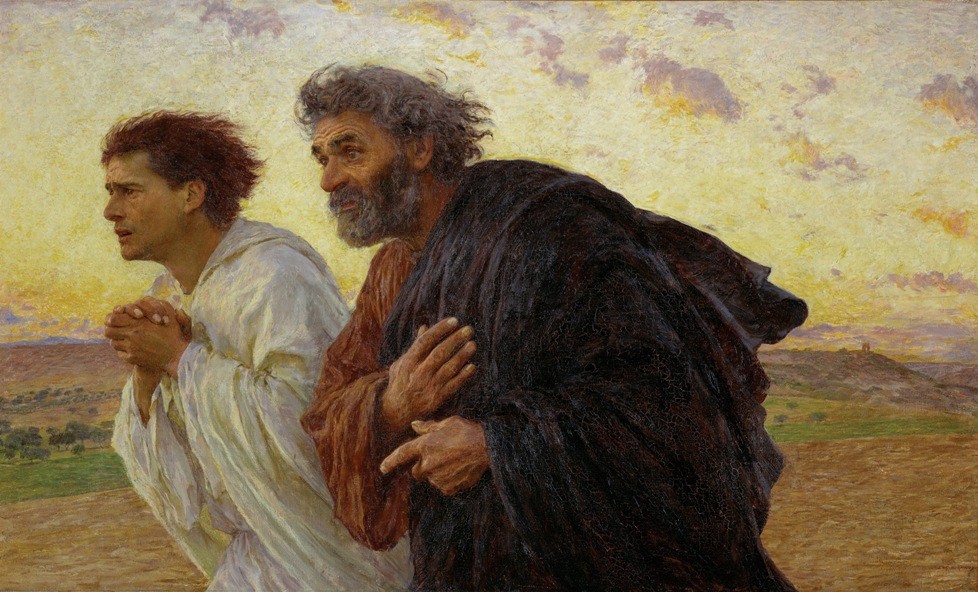
Sometimes a masterpiece of art speaks a million words. In 1889, a Swiss painter by the name of Eugene Burnand created a spectacular piece named Les Disciples. Known as being a deeply religious man, Burnand was primarily a realist painter of nature – including animals and landscapes. Yet as he grew into an artist depicting human figures, his portrayals were captivating and telling. I was introduced to Les Disciples by a friend after church on Sunday.
The painting is of the disciples John and Peter on Easter morning – the morning of the resurrection. Behind them, a brilliant new dawn is breaking. Morning has come, and sunlight is striking every blade of green grass. The movement in the painting is telling – John and Peter are leaning forward, as if in a hurried state. Perhaps they were running – at the least, there was an urgency in their movement. John, the younger disciple, has his hands clasped in front of him. His brow is furrowed, as if he is straining to see something in the distance. Peter, aged with a beard and weathered lines, is closely behind. I love to imagine that in his youth, John is a few steps ahead. Yet Peter, in his heartbreak and shame, cannot be restrained by his age – he is on John’s heels. Peter’s right hand rests on his chest, as if counting the rapid cadence of his own heartbeat. His face is wild with wonder – eyes bright and wide. Can he already see something that John is straining to see as well? Or perhaps Peter has a look of desperation. Could it be true? All that Mary just said to them…is there any way? Together, the disciples are running, straining, and hoping.
The chapter of John 20 recounts the morning of our Savior’s resurrection. Alongside the staggering beauty and glory of the empty tomb, God’s Word also reveals humbling examples of the flesh. Immediately, we resonate with the doubting. I can imagine Mary. Heartbroken and so deeply, deeply sad. How could anything undo the horror of Friday? Everything has changed for Mary, and nothing could begin to heal what is so broken. But what’s that? An empty tomb? Folded grave clothes? How can it be? It makes no earthly sense. Mary’s doubts shout loud. But a voice behind her is even louder. “Mary,” Jesus says. To the doubting heart, Jesus speaks our name. He moves towards us.
We resonate with the failing. I can imagine Peter – as in the painting – clutching his chest and running with frantic eyes. As he runs, each step pounds with a hope that he cannot comprehend. When he has failed so sensationally, how can there be redemption? What could ever undo the death of his beloved friend? Additionally, what could ever undo his own horrible failures? Yet when he arrives, the tomb is empty. Upon seeing his resurrected friend, Peter’s failure is overturned. To the failing, Jesus restores us.
We resonate with the grieving. Some of us do not have to simply imagine what it would have been like to be Mary. We are well acquainted with the journey of grief. Yet, we can gain such comfort from her experience on that early Sunday morning. In her deep grief and even despair, Mary’s Savior and friend is standing with her. To the grieving heart, Jesus gives us His tender nearness.
Like John and Peter, let us run towards the empty tomb. There, beside the stone that has been rolled away, we can leave our doubts, failures, and grief. If Christ is risen, nothing else matters.
About the Author

Ann Higginbottom
Ann Higginbottom was born and raised in Dallas. She is a graduate of Texas A&M University, a proud wife to Robby and mother to their two boys, Will and John. Ann is the Executive Director of Kershaw’s Challenge and author of several books. Robby and Ann love raising their boys in the same community where they grew up, close to family and involved in the school district.